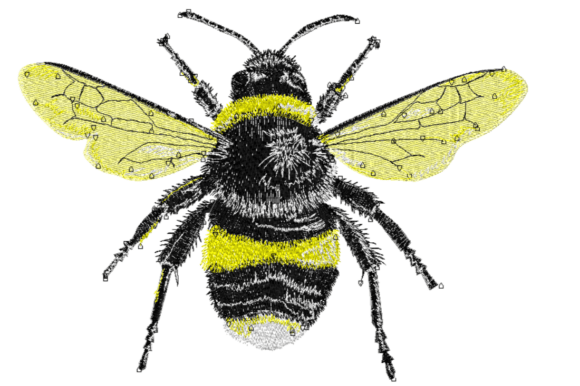
Fuzzy Bumblebee: A Designer Review for Business Merch
As an embroidery designer who specializes in commercial branding and merchandise production, I approach every new machine embroidery design with a critical eye. When evaluating the "Full-Colour Fuzzy Bumblebee Embroidery Design," my primary focus is not just on its aesthetic charm, but on its technical viability for small business applications. This review assesses whether this nature-inspired illustration can transition from a digital file to a profitable asset for cafes, boutiques, florists, and handmade brands.
First Impressions: Visual Personality and Brand Alignment
Upon loading the embroidery file, the Fuzzy Bumblebee immediately presents as vibrant and meticulously rendered. For business owners, first impressions dictate customer trust. This design strikes a balance between playful and professional. It avoids looking like generic clip art; instead, it possesses a textured, illustrative quality that suggests high-value handmade product aesthetics.
For a local bakery or florist, this visual warmth is essential. The "fuzzy" aspect implies texture, which translates beautifully in thread. However, for more corporate or industrial clients, the vibrancy must be managed carefully to ensure it aligns with existing brand identity. The design feels organic and friendly, making it ideal for businesses that want to project approachability, sustainability, or artisanal quality. It is less suited for sterile, tech-forward environments unless used specifically as a softening accent element.
Commercial Applications: From Patches to Uniforms
The true test of any digital embroidery file is its versatility across different merchandise types. In my experience outfitting small businesses, the Fuzzy Bumblebee shows strong potential in several key areas:
- Embroidered Patches: This is perhaps the strongest use case. The distinct shape of a bumblebee lends itself perfectly to patch borders. For outdoor brands or scout troops, these patches serve as collectible small business merch that customers actually want to buy and display.
- Apron Embroidery: For cafes and bakeries, placing this design on the chest or pocket area of an apron adds character without overwhelming the staff uniform. It acts as a subtle logo accent rather than a dominant billboard.
- Tote Bag Design: Canvas totes are staples for Etsy sellers and market vendors. The full-color rendering allows the bee to pop against natural cotton, creating a premium feel that justifies a higher price point for the finished product.
- Cap Embroidery: While possible, caps require careful consideration (discussed below). If executed correctly, a centered bee on a dad hat or trucker cap offers excellent visibility for garden centers and pet brands.
Technical Considerations and Production Risks
While the Fuzzy Bumblebee is visually striking, commercial embroidery requires navigating physical limitations. As a designer, I must highlight where caution is necessary to prevent production waste and client dissatisfaction.
Stitch Density and Fabric Texture
The description notes the design is "meticulously rendered," which often implies higher stitch density to achieve that fuzzy, shaded effect. High density looks beautiful on stable fabrics like denim, canvas, or twill. However, if you attempt to run this on lightweight knits, performance polyester, or sheer fabrics without adequate support, you risk puckering or fabric distortion. Always match the design’s complexity to the fabric texture. For lighter garments, you may need to request a low-density version or use a heavy-duty stabilizer to maintain structural integrity.
Sizing and Detail Retention
Nature illustrations often contain fine details that do not scale down linearly. Before committing to bulk production of small patches or sleeve logos, verify the minimum viable size. If the Fuzzy Bumblebee is reduced too much, the internal shading may turn into a solid block of thread, losing the "fuzzy" definition. Conversely, enlarging it significantly for a jacket back might reveal gaps in coverage if the original digitizing was optimized for a smaller hoop. Always confirm the recommended hoop size range before purchasing.
Curved Surfaces and Caps
Applying detailed, full-color designs to curved surfaces like caps is technically demanding. The Fuzzy Bumblebee’s shape is advantageous here compared to rectangular logos, but the saturation must be monitored. Excessive thread buildup on a cap front can cause needle breaks or registration issues. Test runs on scrap caps are non-negotiable for this application.
Impact on Brand Value and Customer Engagement
Why choose a specific insect motif over a generic logo? In the current market, specificity sells. Using a high-quality Fuzzy Bumblebee signals attention to detail. For an Etsy seller, this elevates the perceived value of custom apparel beyond basic print-on-demand items. Customers associate intricate embroidery with longevity and care.
Furthermore, consistent use of this design across design assets—from packaging stickers to staff uniforms—builds visual recognition. A well-executed embroidered bee becomes a mascot for the brand, fostering emotional connections that text-only logos cannot achieve. It transforms a transactional purchase into an engagement with a story, particularly for eco-conscious or nature-focused businesses.
Professional Designer Notes for Implementation
To ensure your investment in the Fuzzy Bumblebee yields professional results, follow this pre-production checklist. These steps separate hobbyist outcomes from commercial-grade merchandise:
- Verify Licensing: Before selling any item featuring this design, confirm the commercial licensing terms. Ensure you have the right to use the embroidery file for branded merchandise and resale.
- Create a Printable Mockup: Never approve a production run based solely on screen visualization. Generate a printable mockup at actual size to evaluate proportions relative to pockets, seams, and plackets.
- Test in Black and White: Run a grayscale test stitch-out first. This reveals the underlying structure and shading transitions without the distraction of thread colors. If the design reads well in monochrome, it will be successful in color.
- Audit Thread Contrast: Check the designated thread palette against your specific brand colors. You may need to swap shades to ensure the bee matches your company’s Pantone references while maintaining internal contrast for visibility.
- Stabilizer Selection: Do not rely on tear-away stabilizer alone for high-density areas. Use a cut-away backing for stretchy fabrics and consider a water-soluble topping for textured materials like terry cloth or fleece to prevent stitches from sinking.
- Wash Testing: If this design is intended for work shirts or aprons that face frequent laundering, wash and dry a sample three times. Inspect for thread shrinkage, color bleeding, or edge lifting. Durability is part of your brand promise.
- Compare Beside Existing Assets: Print the test stitch-out and place it next to your current business cards, website screenshots, and other merch. Ensure the Fuzzy Bumblebee complements rather than clashes with your established visual ecosystem.
Final Verdict for Small Business Owners
The Full-Colour Fuzzy Bumblebee Embroidery Design is a robust candidate for businesses seeking to add organic warmth and artisanal credibility to their merchandise. Its strength lies in its ability to function as both a standalone focal point for patches and bags, and as a supportive accent for uniforms. However, its success depends entirely on respecting technical constraints regarding density, sizing, and fabric compatibility.
By treating this machine embroidery design as a professional asset rather than a simple decoration, and by adhering to rigorous testing protocols, small business owners can leverage this charming illustration to build lasting brand equity. Always prioritize the technical specifications provided with the file, and when in doubt, consult with your digitizer or run comprehensive tests before scaling production. The result will be merchandise that looks as good in a customer's hands as it does on your screen.